How to Crown Yourself King of SEO: An Entity SEO Checklist
By Andrew Scherer · Aug 21, 2026
Local SEO is stupidly easy right now because it's one of the last places AI hasn't touched. Entity SEO is the opposite. It's where the AI lives. AI Overviews, ChatGPT, Perplexity, and Google's Knowledge Graph all run on entities, and they all ask the same question about your brand: do we actually know who this is, and are we confident about it?
A confident entity is one that search engines and AI have corroborated: multiple independent sources all agreeing on the same facts about you. That's the whole game. Think of it like NAP consistency in local SEO, except instead of your address, you're keeping every fact about your brand consistent everywhere Google looks. Do that, and you earn a Knowledge Panel, get trusted as a source, and get cited in AI answers.
The power of moving an entity: the "King of SEO" stunt
Here's how much leverage a little PR budget buys, and how fast it moves. The "King of SEO" is a running joke in the search industry, and in August 2026 it turned into a live experiment. On August 20, a syndicated press release crowned Kasra Dash the "new King of SEO." A day later, on August 21, another release declared the whole thing a practical joke: "Palace officials and the League of SEOs" confirming that David Quaid keeps the title through 2027, with Dash graciously "pardoned." Both ran on high-authority domains (Globe and Mail, Barchart); both are syndicated press releases, not journalism, each stamped "we have not reviewed or endorsed this content." No journalist checked a word of it.
And the machines took it at face value. Because AI answer engines largely repeat whatever ranks, Google's AI Overview now reports Quaid as the reigning "King of SEO," narrating a two-day PR skirmish back to you as settled fact, no fact-check required. That's the whole lesson in one absurd example: with a small narrative and a little PR budget, you can make almost anything true in the machine's eyes, at least until someone buys the next headline.
That's the raw power of entity manipulation, and it's why entity SEO matters. The honest takeaway isn't "go crown yourself." It's that authoritative, corroborating mentions genuinely move your entity, so the rest of this checklist is about earning real ones. One page is gameable; a web of independent, credible sources is not. Everything below builds the second kind.

Long live the King of SEO. A crown you can apparently buy with a press release.
And it works. Here's a real Google result for "king of seo". The AI Overview and the top stories all trace straight back to those syndicated press releases:
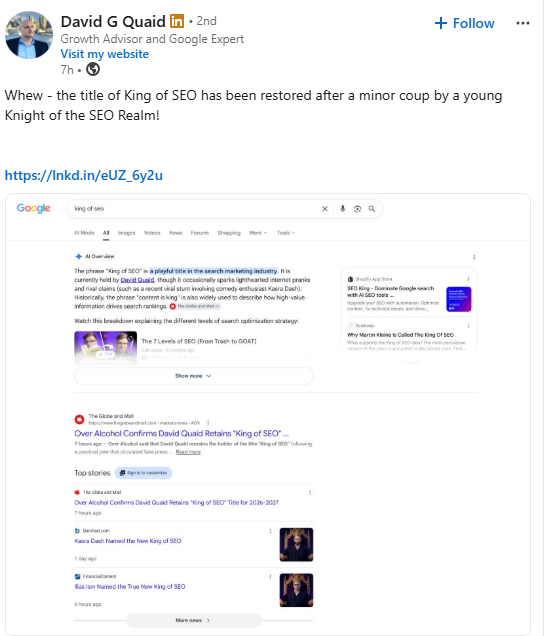
Screenshot via David Quaid on LinkedIn. Google's AI Overview and "Top stories" repeat the press releases at face value, even listing the contradictory "Quaid retains the title" and "Dash named the new king" headlines side by side, with no attempt to reconcile them.
Here's the checklist. Work top to bottom.
(New to the concept? Start with the Entity-Based SEO guide, then come back here.)
1. Entity Home & core identity
Your Entity Home is the one page you fully control that is the authoritative source about your brand, usually your homepage or /about. Google and AI treat it as your source of truth, so nail this first. (The term comes from Jason Barnard / Kalicube, who specializes in exactly this.)
- ☐ Establish a clear Entity Home and make it obvious it's the definitive page about your brand.
- ☐ Pick one canonical brand name and use it identically everywhere: no variations, abbreviations, or "Inc." on some profiles and not others.
- ☐ Write one short, repeatable definition of what you are ("X is a [category] that [does thing] for [audience]") and reuse it verbatim.
- ☐ Lock down your core facts: founding date, founders, headquarters, category, and logo.
- ☐ Use one consistent logo and brand imagery across every profile and platform.
- ☐ Make sure your Entity Home links out to all your official profiles (see structured data below).
2. Structured data: the machine-readable you
This is your schema section. It's how you tell the machines which entity you are instead of hoping they guess right. (Google's structured data docs are the reference.)
- ☐ Add
Organizationschema to your site (orLocalBusinessif you're local too). - ☐ Fill in
name,legalName,description,foundingDate,founder, andlogo. - ☐ Add the
sameAsproperty linking to every official profile: Wikipedia, Wikidata, LinkedIn, Crunchbase, socials. This is the single most important entity signal you control. - ☐ Use
knowsAboutto declare the topics/entities you're an authority on, then back it up with content (section 4). - ☐ Add
Personschema for your founders and key authors, each with their ownsameAs. - ☐ Add
WebSiteschema withSearchActionso your site is machine-navigable. - ☐ Reference the same entity consistently across pages (stable
@ids) so you're not read as several different things. - ☐ Validate everything in Google's Rich Results Test. Broken schema is worse than none.
3. Corroboration across the web
The "citations" section, but for facts, not your address. Confidence comes from independent sources agreeing. One contradiction and confidence drops.
- ☐ Create or claim a Wikidata entry: it's open, anyone can add one, and it feeds the Knowledge Graph directly.
- ☐ Pursue a Wikipedia entry if you're genuinely notable (real coverage exists); don't force it if you're not.
- ☐ Get listed where Google confirms entities: Crunchbase, LinkedIn company page, industry bodies, relevant directories, Google Business Profile.
- ☐ Make sure every source states the same facts: founding date, founders, HQ, name. Consistency is the whole point.
- ☐ Earn mentions on sites Google already trusts as authoritative in your niche.
- ☐ Fix stale or wrong facts about you wherever they appear; outdated corroboration is anti-corroboration.
- ☐ Keep an internal "source of truth" doc so everyone publishes the same facts.
4. Map your entity strategy before you write
Declaring knowsAbout means nothing if your content doesn't cover the topic, and the fastest way to know what to cover is to map it before you write a word. Spend two minutes building a contextual entity map and you walk out with a plan: every subtopic, related entity, and search intent your article needs to be considered complete. It's the difference between guessing and having a strategy.
Here's a map for "local citations" built in Entity Explorer in about a minute:
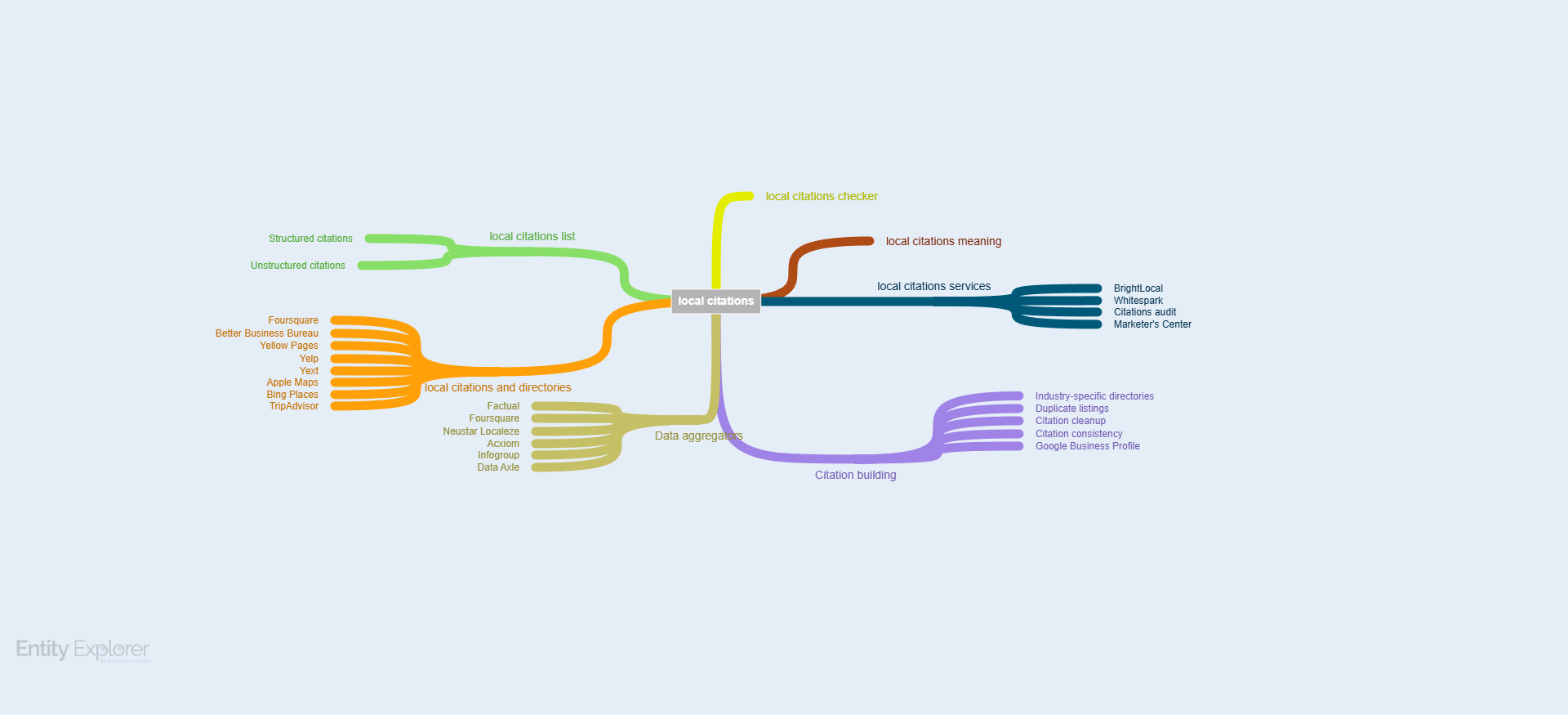
Look at what it hands you for free: the core directories (Foursquare, Yelp, Yext, Apple Maps, Bing Places), the data aggregators most writers forget (Acxiom, Infogroup, Data Axle, Neustar Localeze), the sub-angles (structured vs. unstructured citations, citation cleanup, NAP consistency), and the adjacent intents people actually search (citations checker, meaning, services). That one view is your article outline, your internal-link plan, and your entity-coverage checklist, before you've written a sentence.
- ☐ Map your topic's full entity neighborhood before drafting: the things a genuine expert would cover (map it here).
- ☐ Turn each major branch into a section, and each leaf into a point you cover.
- ☐ Cover those entities in the content itself, not just keyword variations.
- ☐ Build a pillar → cluster structure: one comprehensive hub, deep supporting pages.
- ☐ Interlink the clusters so the architecture is explicit. This is exactly what Brand Vaults are for.
- ☐ Export your entity map (JSON) and hand it to a writer or an AI model as the exact coverage spec.
5. Author & people entities (E-E-A-T)
Entities aren't just brands. Your people are entities too, and confident authors lift the whole site's trust.
- ☐ Give every author a real bio with genuine credentials.
- ☐ Mark up authors with
Personschema and consistentsameAslinks to their professional profiles. - ☐ Keep each author's identity identical across the web (same name, same photo, same bio facts).
- ☐ Build your key authors into recognized entities in their own right (talks, bylines, interviews).
- ☐ Connect authors to the brand entity (
worksFor/authorrelationships).
6. Brand demand & co-occurrence signals
The "behavioral signals" section. Google learns an entity matters when the world acts like it does.
- ☐ Drive branded searches: people Googling your name is one of the strongest "this entity is real and matters" signals (fuel it with ads, PR, and job listings).
- ☐ Engineer co-occurrence: get named alongside the right topics and entities so Google files you in the right neighborhood.
- ☐ Chase brand mentions, not just links; unlinked mentions still corroborate.
- ☐ Keep social profiles active, consistent, and linked from your Entity Home.
- ☐ Earn press that names the brand in context.
- ☐ Encourage direct traffic and repeat visits; real demand is hard to fake.
7. Disambiguation & the Knowledge Panel
Unique to entities: there's no local-SEO equivalent. If Google can't tell you apart from a similarly-named thing, it stays unsure.
- ☐ Identify anything you could be confused with (same/similar name) and make yourself distinct.
- ☐ Add distinguishing context and schema so your category and relationships are unambiguous.
- ☐ Query the Knowledge Graph and just Google your brand to see what the machine currently believes.
- ☐ Claim your Knowledge Panel the moment it appears; it's the visible proof you've become a confident entity.
- ☐ Keep the panel's facts correct and complete over time.
8. Monitoring & proof of confidence
Your "tracking" section. Confidence is measurable if you watch the right things.
- ☐ Search your brand regularly and check for a Knowledge Panel (and how complete it is).
- ☐ Track branded search volume over time in Search Console; it should trend up.
- ☐ Monitor entity mentions and sentiment across the web.
- ☐ Re-run the Rich Results Test after any site change that touches schema.
- ☐ Watch which of your pages get cited in AI Overviews / assistants.
- ☐ Keep an eye on your Wikidata/Wikipedia entries for edits or vandalism.
9. Grey areas & traps to skip
Your local checklist ends with a black-hat bonus round. For entities, the "shortcuts" are almost all about faking corroboration, and they backfire specifically because entity confidence is built on independent sources agreeing. Here's what people try and why it's a bad trade:
- ☐ Don't spam or vandalize Wikidata/Wikipedia; edits get reverted and it torches your credibility with the sources that matter most.
- ☐ Don't invent facts (fake awards, inflated founding history). One source that contradicts the rest lowers Google's confidence.
- ☐ Don't buy low-quality mentions/links en masse; noise from untrusted sources doesn't corroborate anything.
- ☐ Don't spin up fake "author" personas; hollow E-E-A-T is easy to detect and unwinds trust.
- ☐ Don't keyword-stuff your brand name or schema; it reads as manipulation, not identity.
- ☐ Do the boring, honest version instead: consistent facts, real coverage, genuine mentions. It compounds; the shortcuts unwind.
The one-line version
Make every source Google and AI can find say the same true things about you, then prove it with content that actually covers your topic. That's a confident entity.
Further reading: Jason Barnard / Kalicube on Entity Home and Knowledge Panels; Dixon Jones on entity SEO; and our own Entity-Based SEO guide.
Entity Explorer is a free tool by Marketer's Center. Map your topic's entities, plan your coverage, and build the topical authority a confident entity needs. Start here.