Google Business Name Guidelines: What Still Works Today and What Doesn't
By Andrew Scherer · Aug 27, 2026
Google Business Name Guidelines: What Still Works Today and What Doesn't
Search "Sacramento handyman" on Google and a business literally named Sacramento Handyman sits at #1, on page one, without much SEO muscle behind it. That's not a business winning a generic keyword through months of content and backlinks. That's a business whose exact name and the single most valuable, most-searched term in its entire local market are the same string of words, ranking first for it.
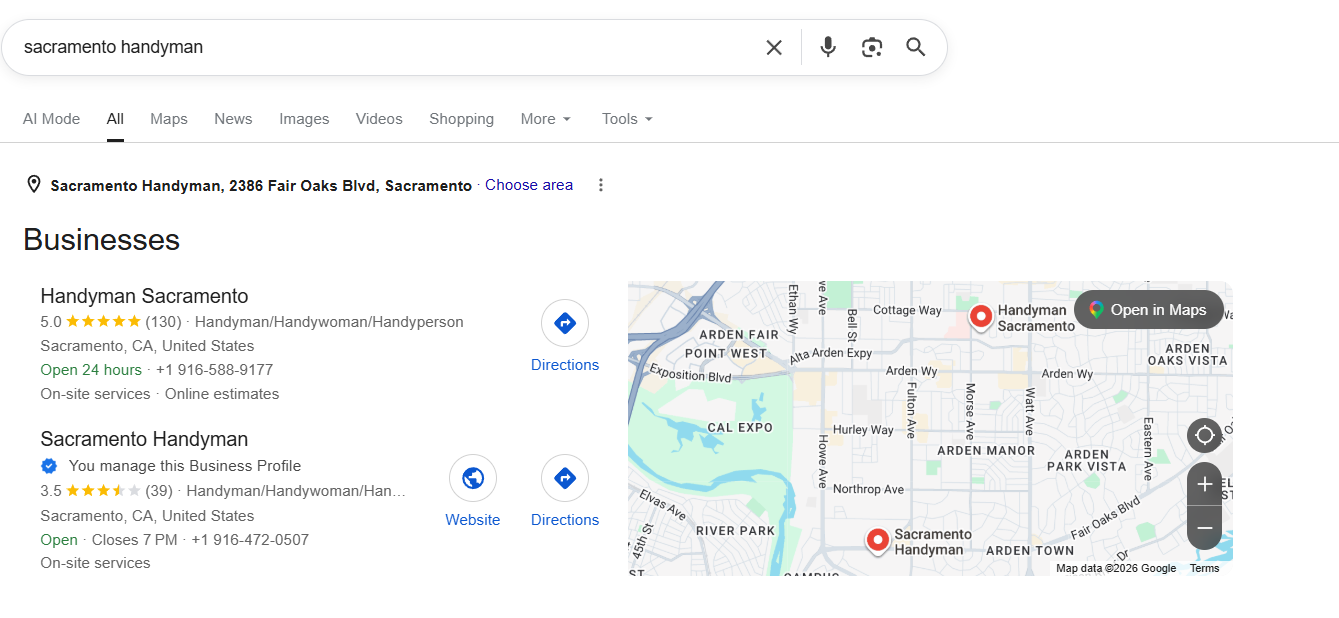
The keyword-in-name superpower is real, and now we have proof
We built Sacramento Handyman as a website and Google Business Profile, and watching it land at #1 for "Sacramento Handyman" turned a theory we'd suspected for years into something we could actually point to. The idea has always been that Google treats a keyword sitting inside a business name the way it treats an exact match domain, giving it a ranking boost tied directly to the brand matching the query itself. That's been floating around as speculation in SEO circles for a long time. Sacramento Handyman is the observed outcome, with an actual rank position attached to it. The name isn't hinting at relevance, it is relevance, and Google's algorithm appears to reward that overlap the same way it rewards an EMD.com domain matching a search term.
That's also why we paired the name with an EMD.com domain instead of picking one or the other. When the keyword shows up identically in the business name, the domain, and the Google Business Profile, it stops looking like isolated keyword usage and starts compounding. Google seems to read that repetition across every touchpoint as a brand signal, not just a keyword mention, and brands get benefits that keywords alone don't earn. Sacramento Handyman is what that compounding effect looks like when it actually plays out, not just when it's argued about in a forum thread.
Don't rename your business just to chase this
The catch is timing. This works cleanly when the name is decided before the Google Business Profile exists and before the website goes live. If you rename an established business after the fact just to jam in a keyword, you're stuck untangling old citations, retraining reviewers who knew you under the old name, and waiting on a Knowledge Panel that takes its time catching up. People searching "google my business name change" usually want to know if a rename hurts their rankings or reviews, and the honest answer is that it can slow both down while everything resyncs. This is a decision for day one, not something you patch in mid-campaign. Most of what we do at Marketer's Center revolves around getting a Google Business Profile ranked and keeping local rankings climbing, so this is exactly the kind of decision we help map out before it turns into a mess later.
The pipe-stuffing era got patched, mostly
There used to be a common workaround where businesses crammed extra keywords into the name field using pipes, something like "Marketer's Center | White Label Local SEO | Local Citations." It showed up most in competitive trades like law firms, where every extra keyword in the title felt worth the risk. Google's guidelines have closed that loophole on paper, and a case study reviewing dozens of keyword-stuffed listings found that enforcement leans almost entirely on manual review triggered by competitor complaints, that stuffed names still produce real ranking boosts, and that 60% of violators got only a warning instead of a suspension. Even stranger, 100% of the businesses studied added the keywords right back after getting flagged, with some repeating the cycle 8 or more times without ever getting banned. The rule against stuffing exists. Getting caught and actually punished for it is the part that's inconsistent.
Enforcement is still inconsistent today
That inconsistency isn't just a 2024 case study problem. A Google Business Profile support thread from January 2026 shows a competitor reporting QIT Solutions for a stuffed listing, and a Diamond Product Expert named Stefan Somborac replies that in his experience Google won't act "unless the keyword stuffing in the name is really bad."
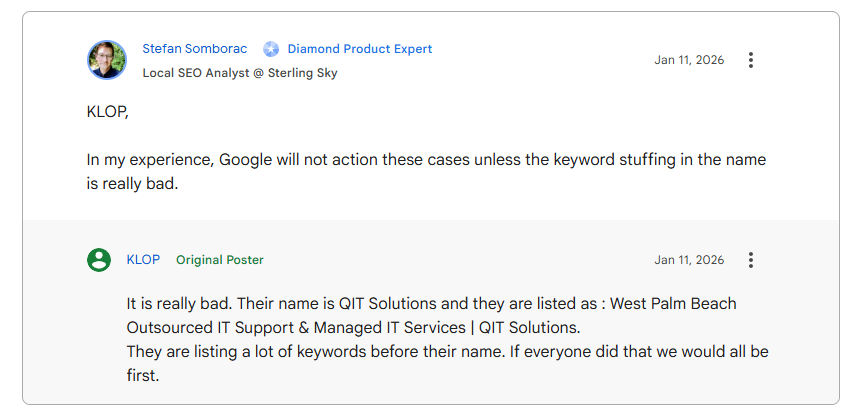
As of today, six months after that thread, QIT Solutions is still running live with the title "West Palm Beach Outsourced IT Support & Managed IT Services | QIT Solutions."
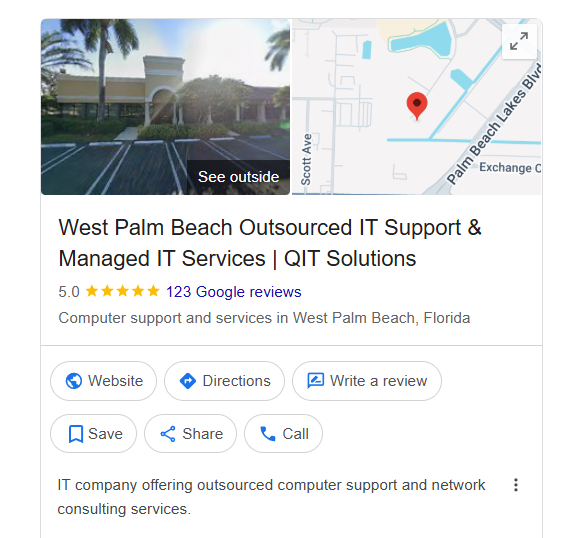
That's the reality behind the google my business name character limit and the google my business name policy questions people keep asking in forums like r/localseo, where the debate over how much a keyword in your GMB name actually moves rankings never really settles. The tactic can work for a long stretch, right up until a competitor figures out exactly how to word the complaint.
The rules contradict themselves for chains and brands
Google's own guidelines don't even agree with each other on this. Under the "Location information" section of Google's guidelines, the instruction is to avoid a location-descriptor name like "Holiday Inn (I-93 at Exit 2)" and use "Holiday Inn Salem" instead. That's Google telling you to include the location in the name.
Then, under "Chains and brands" in that exact same guidelines document, Google flips it. The example given is "The Home Depot at Springfield" listed as not allowed, with the name required to be just "The Home Depot." No location included at all.
Those two sections are sitting in the same official document contradicting each other on the same question. For a service-area business especially, where you don't want customers calling a location two counties over because they can't tell which listing covers them, allowing a location qualifier in the name makes practical sense. Google's own guidelines just don't agree with themselves on whether that's allowed.
How to actually report a keyword-stuffed name
If a competitor is running a stuffed name and you want it fixed, there are two methods that actually work. The first is the "Suggest an edit" feature directly on their listing. The second, and usually the more effective one, is the Business Redressal Form.
Neither of these is instant. This takes babysitting, and it can take several weeks to see any movement. Initial redressal submissions sometimes come back rejected on the first pass, but following up on the assigned Case ID often gets it resolved the second time around.
Close it out
A keyword in your business name is a real advantage when it's your actual name, chosen before the GBP and the website ever go live, and reinforced with an exact match domain. Sacramento Handyman ranking #1 for its own name shows what that advantage looks like when it's earned honestly. Stuffing it in after the fact with pipes and extra services turns your listing into a bet on whether a competitor bothers to file the right report. If you're weighing a name-and-domain strategy for a new location or a new brand, Marketer's Center can help you map it out before you're locked into a name you can't walk back.
FAQ
Does changing your GMB name hurt rankings?
It can slow things down while everything resyncs. Old citations fall out of sync, reviewers who knew the business under the old name get confused, and the Knowledge Panel takes time to catch up. A rename isn't fatal, but it's a disruption you avoid by picking the right name before the profile and website ever go live.
What is the Google Business Profile name character limit?
Google doesn't publish one clean number that stays fixed, but names that read like they're padded with extra keywords and services tend to draw scrutiny regardless of length. The safer approach is naming the business what it actually is rather than trying to max out how much fits in the field.
Is keyword stuffing in the business name against Google's policy?
Yes, it's against the guidelines on paper. In practice, enforcement is manual and mostly triggered by competitor complaints, and a case study found 60% of violators got only a warning while 100% of them added the keywords back after being flagged.
How do you report a competitor's keyword-stuffed listing?
Use the "Suggest an edit" feature on the listing itself, or file through the Business Redressal Form, which tends to be more effective. Expect it to take weeks, and if the first submission gets rejected, follow up on the assigned Case ID rather than starting over.
Does a keyword in the business name still help local SEO?
It appears to, based on cases like Sacramento Handyman ranking #1 for its own name. Google seems to treat the match between the name and the search term the way it treats an exact match domain, especially when the name, domain, and profile all repeat the same keyword.
Do chains and service-area businesses follow different naming rules?
Google's own guidelines contradict each other here. One section tells brands to include the location in the name, like "Holiday Inn Salem," while the chains and brands section says the opposite, rejecting something like "The Home Depot at Springfield" in favor of just "The Home Depot." For a service-area business, adding a location qualifier still makes practical sense even though Google's documentation doesn't consistently support it.
Frequently asked questions
Does changing your GMB name hurt rankings?
It can slow things down while everything resyncs. Old citations fall out of sync, reviewers who knew the business under the old name get confused, and the Knowledge Panel takes time to catch up. A rename isn't fatal, but it's a disruption you avoid by picking the right name before the profile and website ever go live.
What is the Google Business Profile name character limit?
Google doesn't publish one clean number that stays fixed, but names that read like they're padded with extra keywords and services tend to draw scrutiny regardless of length. The safer approach is naming the business what it actually is rather than trying to max out how much fits in the field.
Is keyword stuffing in the business name against Google's policy?
Yes, it's against the guidelines on paper. In practice, enforcement is manual and mostly triggered by competitor complaints, and a case study found 60% of violators got only a warning while 100% of them added the keywords back after being flagged.
How do you report a competitor's keyword-stuffed listing?
Use the "Suggest an edit" feature on the listing itself, or file through the Business Redressal Form, which tends to be more effective. Expect it to take weeks, and if the first submission gets rejected, follow up on the assigned Case ID rather than starting over.
Does a keyword in the business name still help local SEO?
It appears to, based on cases like Sacramento Handyman ranking 1 for its own name. Google seems to treat the match between the name and the search term the way it treats an exact match domain, especially when the name, domain, and profile all repeat the same keyword.
Do chains and service-area businesses follow different naming rules?
Google's own guidelines contradict each other here. One section tells brands to include the location in the name, like "Holiday Inn Salem," while the chains and brands section says the opposite, rejecting something like "The Home Depot at Springfield" in favor of just "The Home Depot." For a service-area business, adding a location qualifier still makes practical sense even though Google's documentation doesn't consistently support it.